The other day, I was shopping for a tablet, when I came across a brand name that I hadn’t seen in a long time: OnePlus. The name bought back a flood of memories of when I was a teenager: OnePlus One, « Never Settle », a phone you could only get on invite, and a general time where tech companies were racing to outthink each other and show more initiative by releasing increasingly innovative (and sometimes wacky) products at breakneck speed. Simply put, it was a war.
Back then, I was in it, and not casually either. I read Engadget and The Verge daily, I knew Notebookcheck’s review scores before I knew my own grades, and I ran every PC build I could dream of through CanYouRunIt. I could tell you the specs of every flagship that mattered, the release cadence of every major brand, which phone had the better camera sensor and why. I had loud opinions. I was an iPhone hater, which is pretty funny to admit now, seeing as I’ve had one in my pocket for the last four years. The whole Android vs iPhone shtick lasted so long that we had a debate once about it in my English club, and I participated like any of it mattered, in the grand scheme of things. If all of this sounds a bit cringe to you, you’re probably right, but it was the energy of the time and I had it bad.
These days a new phone comes out, adds a slightly better camera and a marginally faster chip, and we barely look up. The annual releases are pretty much non events: Yeah, the iPhone 17 is coming out, what does it matter? Bland. But back then? Oh boy. Let me tell you about back then.
Picture the landscape. Every spec was a battlefield, and I watched most of it unfold through LG, because that’s what I carried. First the Optimus G Pro, then the G5, a phone with a fingerprint scanner on the back, an infrared blaster that doubled as a universal remote (Professor Seth, I’m the one who turned off the projector during CS class, if you’re reading this, I’m sorry), and a modular bottom you could physically slide off to swap in accessories. And this 007 gadget of a phone was hardly the strangest thing out there.
Screen resolution climbed inch by inch, brands one-upping each other until Android flagships were pushing 1440p while Apple held the line at a lower resolution and told us, straight-faced, that the human eye couldn’t tell the difference past a certain point. Convenient, that. Cameras fought megapixel by megapixel. Phones grew until “phablet” stopped being a punchline and became a category. The one I never owned but badly wanted was the V10, with a little second screen perched above the main display, a separate strip for notifications and shortcuts so they’d never cover what you were watching. The vague spiritual grandfather of the iPhone’s Dynamic Island, years early. Samsung was cramming in every sensor it could find. OnePlus was selling phones by invite only, turning the act of buying a device into a status game.
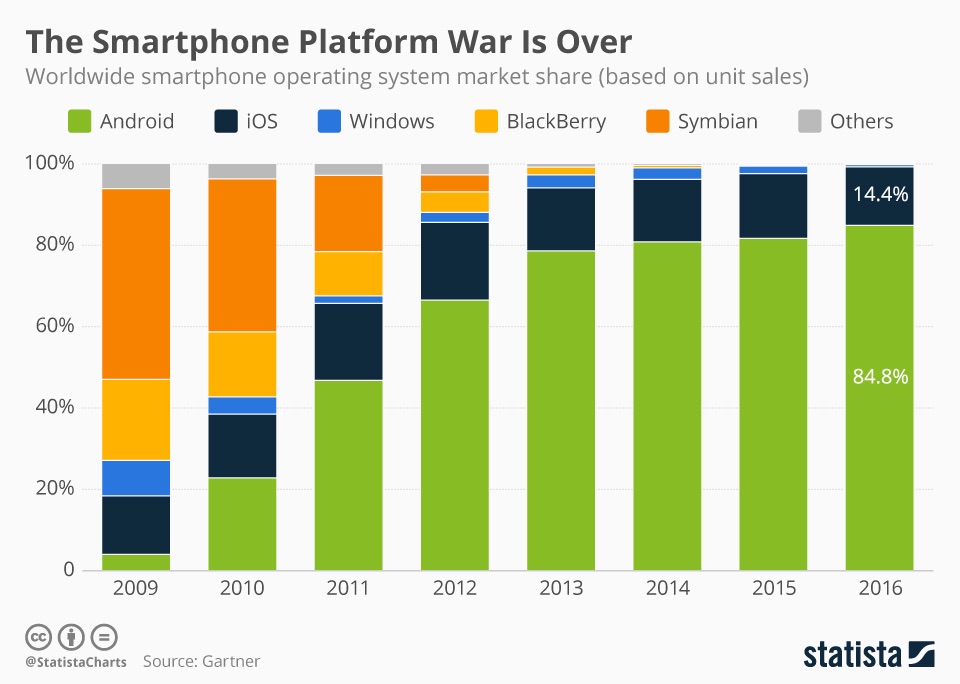
Then, eventually, the questions got answered, and the experiments narrowed with them. Screens got big enough, cameras got good enough and battery, storage, speed all crossed from “not enough” to “fine,” and once something is fine, there’s nothing left to fight about. Everyone had figured out what a phone was supposed to be, and the answer was the same black rectangle, give or take a camera bump. The market consolidated. Apple took the profit, Android took the volume, and the brands too weird to fit that split died. LG, which made my G5, stopped making phones in 2021.
Here is why I’m telling you all this. Because I’m watching it happen again, right now, and this time it is not phones.
Look at the pace. In just over a year, Anthropic alone went from Claude Opus 4 to 4.1 to Sonnet 4.5, Haiku 4.5, Opus 4.5, then 4.6, 4.7, 4.8, and then an entirely new tier above all of it called Fable 5, each one landing every few weeks. And that is just the models. Alongside them came Claude Code, then Cowork, then Claude in Chrome, in Excel, in PowerPoint, plus computer use, million-token memory, agents that spin up other agents. Sixteen of those agents wrote a working C compiler from scratch. Another helped route a rover on Mars. And Anthropic is one company. OpenAI, Google, and a dozen others are sprinting just as hard, each one announcing “the most powerful model in the world” so often that the title changes hands before you have finished reading the press release. If that doesn’t sound familiar, go back and reread the part about megapixels and screen resolution. It’s the exact same war, fought inch by inch, except the inches are benchmarks now.
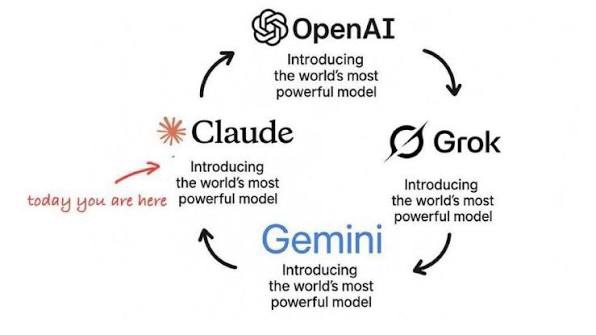
We’re still in the experimenting phase. Nobody actually knows what the finished product is supposed to be yet, the same way nobody knew what a phone was in 2010. The iPhone came out in 2007, and it took well over a decade before the innovation slowed and phones settled into the boring black rectangles we carry today. AI is nowhere near that point. We’re still bolting second screens onto things, still throwing wild ideas at the wall to see what sticks. Which means the flood of new models, new features, and genuinely strange new use cases isn’t slowing down anytime soon. If anything, we haven’t seen the strangest stuff yet.
So who is who in this version of the war? The way I see it, the providers are already splitting the way Apple and Android did, just along a different seam. Anthropic is building the iPhone for companies. Look at where its energy goes: Cowork, Claude in Excel and PowerPoint, the Microsoft 365 and AWS integrations, the enterprise plans. It’s premium, deeply integrated, and aimed squarely at serious work. OpenAI took the other road, putting ChatGPT in everyone’s pocket and making it the default the way Android became the world’s default. Gemini is carving out a niche in image and video content creation. Different business models, different bets, but the same shape: a couple of giants pulling toward the center while everyone else figures out where they fit.
Now, I am not saying this to predict that Gemini disappears or that every company ends up on Claude. I genuinely do not know how this ends, and I don’t believe anyone can predict it. But here is where the smartphone analogy finally breaks: A phone is a tool. The worst a bad phone did was waste your money. AI is a different kind of thing, even though it’s often advertised also as a tool. It can be used well or it can be used to genuinely replace people, to make decisions about them, to do real harm at a scale a phone never could. And we got a preview of how messy that gets: Anthropic released Fable 5, its most capable model ever, and the US government forced it offline worldwide in 96 hours. The smartphone war never had a moment where the state reached in and switched off the best product on the market overnight.
The smartphone war ended in consolidation and boredom, two winners and a lot of sameness. Maybe AI goes the same way. But maybe it doesn’t, because the stakes are not the same, and the referees are not the same, and a tool that can replace the people using it is not really just a tool. I don’t have the answer. I just recognize the feeling in the air, and I know how the last time felt right before everything settled.
Anyway. That’s how a brand name from my teenage years set off a whole theory about where AI is going in my head, dragged out of a Vinted listing. If anyone has figured out how to just buy a tablet without turning it into a research project and an essay, or just good recommendations in general, my inbox is open and the comments as well. Until then, I’ll be on the couch.


Leave a Reply